
Pune Real Estate Market 2026: Price Trends, Best Localities & Forecast
Published on 25 July 2026 · 7 min read
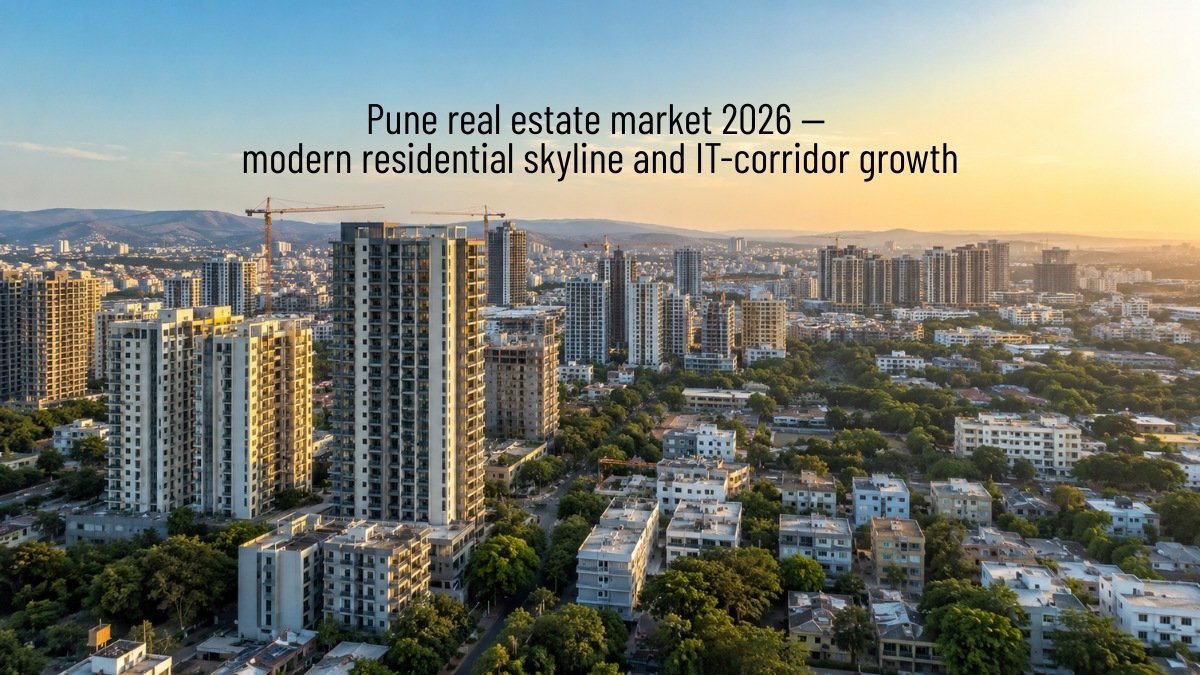
Pune's 2026 real estate market has matured past its multi-year boom into a phase of stable, demand-led growth. Prices are rising a moderate 5–10% a year, IT corridors are leading the way, and metro-connected areas are outperforming everywhere else. Buyers are more selective than they were two years ago, and premium housing is quietly gaining share.
What Is the State of the Pune Real Estate Market in 2026?
The market is in a consolidation phase, not a speculative one. Residential sales dipped roughly 3% in 2025 to about 50,800 units (Hindustan Times), and January 2026 registrations came in around 14,527 units — down 17% year-on-year (Maharashtra IGR) but recovering month-on-month.
- End-user driven demand rather than pure investment flipping
- Gradual price appreciation instead of sharp spikes
- A clear premiumization trend — bigger, better-specified homes
- Buyers preferring RERA-registered projects
- Low unsold inventory in established micro-markets
How Much Do Properties Cost in Pune in 2026?
Prices range from roughly ₹6,000/sq ft on the periphery to ₹14,000+/sq ft in premium IT-corridor and central locations. The 3-/4-BHK share of new launches rose from about 20% to 29% in 2025, and the ₹1–2 crore segment saw roughly 300% growth in units sold since 2021.
| Corridor | Price range (₹/sq ft) | Momentum |
|---|---|---|
| Hinjewadi / Wakad / Kharadi | 7,000 – 14,000 | ~2.5–3.5% per quarter |
| Baner / Aundh / Kothrud | 10,000 – 15,000+ | ~8–12% annualized |
| Koregaon Park / Kalyani Nagar | Highest / luxury band | Steady, low volatility |
| Punawale / Marunji / Hinjewadi fringe | 6,000 – 8,500 | ~10% rental growth |
| Wagholi / Talegaon / PCMC periphery | 5,500 – 7,500 | Entry-level, high volume |
| Hadapsar / NIBM Road / Undri | 7,000 – 10,000 | Steady mid-tier demand |
Rental yields sit around 3–5% for residential (up to 5.5–6% in select micro-markets) and 7–9% for commercial space.
Which Areas in Pune Are Best to Invest in for 2026?
Hinjewadi and its fringe remain anchored by what's often called Asia's largest IT park, employing 400,000+ professionals. Kharadi and Wagholi are benefiting from East Pune's Ring Road growth. Baner–Aundh–Balewadi is the premium band, appreciating 8–12% a year. Wakad and the PCMC periphery (Talegaon, Ravet) offer a more budget-friendly entry point.
- Best for rental yield: Hinjewadi fringe and NIBM Road
- Best for capital appreciation: West Pune and metro-adjacent micro-markets
What Is Driving Pune Real Estate Growth in 2026?
Three forces are doing most of the work: IT-led employment, infrastructure delivery, and a buyer base that's grown more transparency-focused. Metro Line 3 (Hinjewadi Phase 3 → Shivajinagar) cuts a roughly two-hour commute down to about 40 minutes, and properties within 500m of a metro stop are appreciating 15–20% above the local average.
The Pune Ring Road is unlocking Talegaon, Wagholi, and PCMC, while the Purandar airport announcement has already lifted nearby land values. Over 250 engineering colleges keep feeding the IT workforce that anchors demand, and developers like VTP, Kolte-Patil, Goel Ganga, and Sobha continue to shape supply.
What Is the Price Forecast for Pune Real Estate in 2026?
Expected appreciation for 2026–27, by segment:
| Segment | Expected 2026–27 appreciation |
|---|---|
| Established IT corridor | 7–12% |
| West Pune | 8–12% |
| Peripheral / budget segment | Above city average |
| City overall | 5–10% |
The biggest risk sits with interest-rate sensitivity in the ₹1–1.5 crore segment — the RBI's rate trajectory is arguably the single biggest macro variable for this market in the year ahead.
Is 2026 a Good Time to Buy or Invest in Pune?
It's a favorable entry point for end-users and long-term investors. Home buyers should prioritize RERA registration and metro-adjacency; investors chasing yield should look at Hinjewadi fringe and NIBM, while those chasing growth should look at West Pune and the metro corridors. Value hunters can still find room on the Ring Road periphery.
Pune in 2026 is a market to buy into on fundamentals, not to time for a quick flip.
What This Means for Real Estate Businesses in Pune
In a more selective market, visibility and lead quality matter more than raw reach. Buyers research online, compare RERA credentials, and shortlist projects long before they call a sales team — which makes real estate digital marketing the difference between a listing that gets seen and one that doesn't.
For a related read, see our analysis on whether Pune property prices will fall in 2026, and if you're evaluating who to hire for this work, our guide on how to choose a digital marketing agency in Pune is a useful next stop.
Ready to Reach Pune Property Buyers in 2026?
If you're a developer, broker, or agent looking to turn this market's fundamentals into qualified leads, RaRi Softworks runs a free real estate marketing and AI-visibility audit — reach us at 2608, Bramhacorp Business Park, Wadgaon Sheri, Pune, on 020 6901 0276, or at saless@rarisoftworks.com.
Editorial Note
Prices are climbing steadily, infrastructure is reshaping value street by street, and online visibility is now inseparable from selling property in Pune.
Methodology & Sources
This analysis draws on data and reporting from JLL, the Maharashtra IGR, Hindustan Times, and market reports from Blox, Naiknavare, Casagrand, and BeyondWalls, alongside RaRi Softworks' direct work with real estate clients across Pune.