Head Office
2608, Bramhacorp Business Park, Wadgaon Sheri, Pune, Maharashtra 411014 India.
☎️ 020-69010276
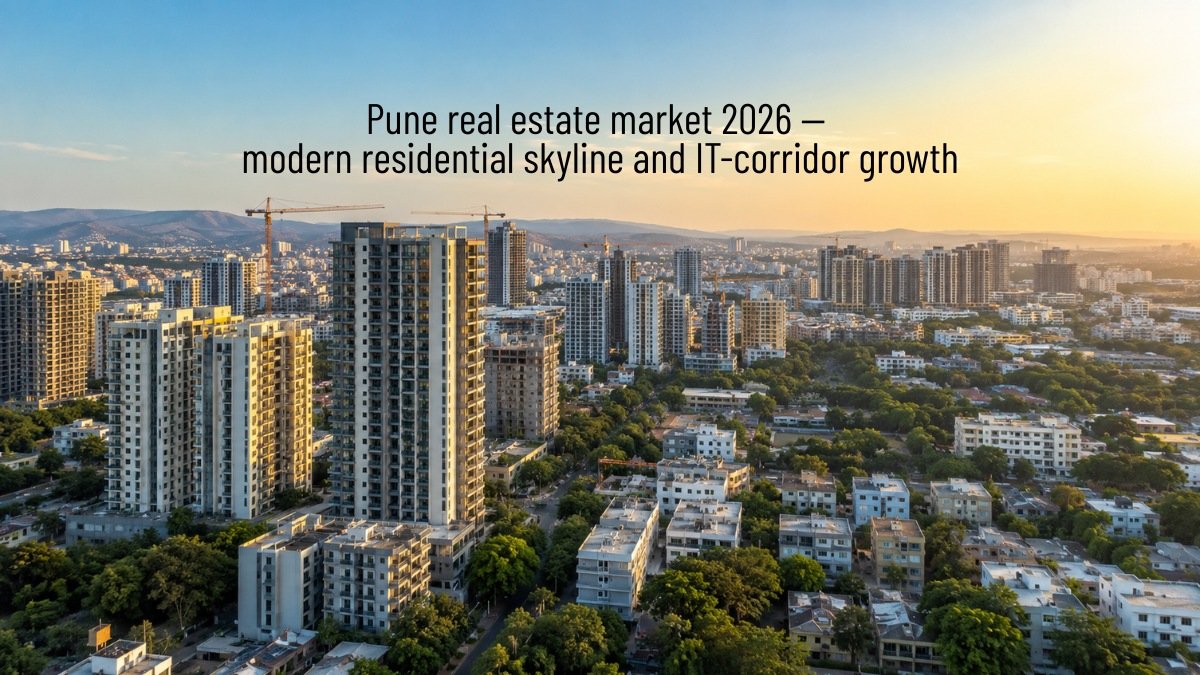
Pune’s real estate market in 2026 is in a phase of stable, demand-led growth — prices are rising at a moderate 5–10% a year rather than spiking, with the IT corridors leading and metro-connected areas outperforming. After a strong multi-year cycle, the market has matured: buyers are more selective, premium housing is gaining share, and infrastructure is redrawing which localities win.
This guide lays out, with current 2026 data, where prices actually stand, which areas are worth watching, what’s driving the growth, and where the market is headed — whether you’re buying a home, investing, or building in Pune. As a Pune-based agency that works closely with real estate developers and agents, we’ve written this to be genuinely useful for both sides of the market.
In 2026, Pune is in a consolidation phase — healthy end-user demand, moderate price appreciation, and a clear shift toward premium homes, rather than speculative overheating.
The signals are mixed but fundamentally sound. Residential sales dipped around 3% in 2025 to roughly 50,800 units as buyers turned selective amid higher prices, according to figures reported by Hindustan Times. Registrations softened early in 2026 — January saw about 14,527 units, down 17% year-on-year per Maharashtra’s registration department (IGR) — but recovered month-on-month from December, signalling renewed activity rather than a slowdown.
Key characteristics of the 2026 market:
The premiumization is striking: 3- and 4-BHK units rose from about 20% to 29% of new launches in 2025, and homes in the ₹1–2 crore band have seen roughly 300% growth in units sold since 2021.
Pune residential prices in 2026 range broadly from around ₹6,000 per sq ft in emerging peripheries to ₹14,000+ per sq ft in premium IT-corridor and central localities, with the mid-premium IT belt the most transactionally active segment.
The table below summarizes approximate 2026 price bands and momentum by corridor. Treat these as directional ranges — actual rates vary by project and configuration.
| Corridor / Localities | Approx. price (₹/sq ft) | Character | Near-term momentum |
|---|---|---|---|
| Hinjewadi, Wakad, Kharadi | ₹7,000–14,000 | Mid-premium IT belt, most active | Strongest — ~2.5–3.5%/qtr |
| Baner, Aundh, Kothrud (West Pune) | ₹10,000–15,000+ | Premium, established | ~8–12% annualised |
| Koregaon Park, Kalyani Nagar | Highest band | Luxury / central | Steady, low-yield |
| Punawale, Marunji, Hinjewadi fringe | ₹6,000–8,500 | Emerging, IT workforce base | High rental growth (~10%) |
| Wagholi, Talegaon, PCMC periphery | ₹5,500–7,500 | Budget, Ring-Road beneficiaries | Sharper future gains |
| Hadapsar, NIBM Road, Undri | ₹7,000–10,000 | Mid-segment, good yields | Stable, strong rental demand |
Ranges are indicative (sourced from 2026 Pune market updates) — verify current rates for specific projects. Rental yields sit at roughly 3–5% for residential (up to 5.5–6% in select areas) and a stronger 7–9% for commercial, making Pune attractive for income-focused investors.
The strongest 2026 opportunities cluster around the IT corridors and metro-connected peripheries — Hinjewadi and its fringe (Punawale, Marunji), Kharadi, Wakad, and the Ring-Road belt (Wagholi, Talegaon).
For pure rental yield, the Hinjewadi fringe and NIBM Road offer the best numbers; for capital appreciation, West Pune and metro-adjacent areas lead.
Three forces are driving Pune’s 2026 growth: sustained IT-led employment, major infrastructure delivery, and a maturing, transparency-focused buyer market.
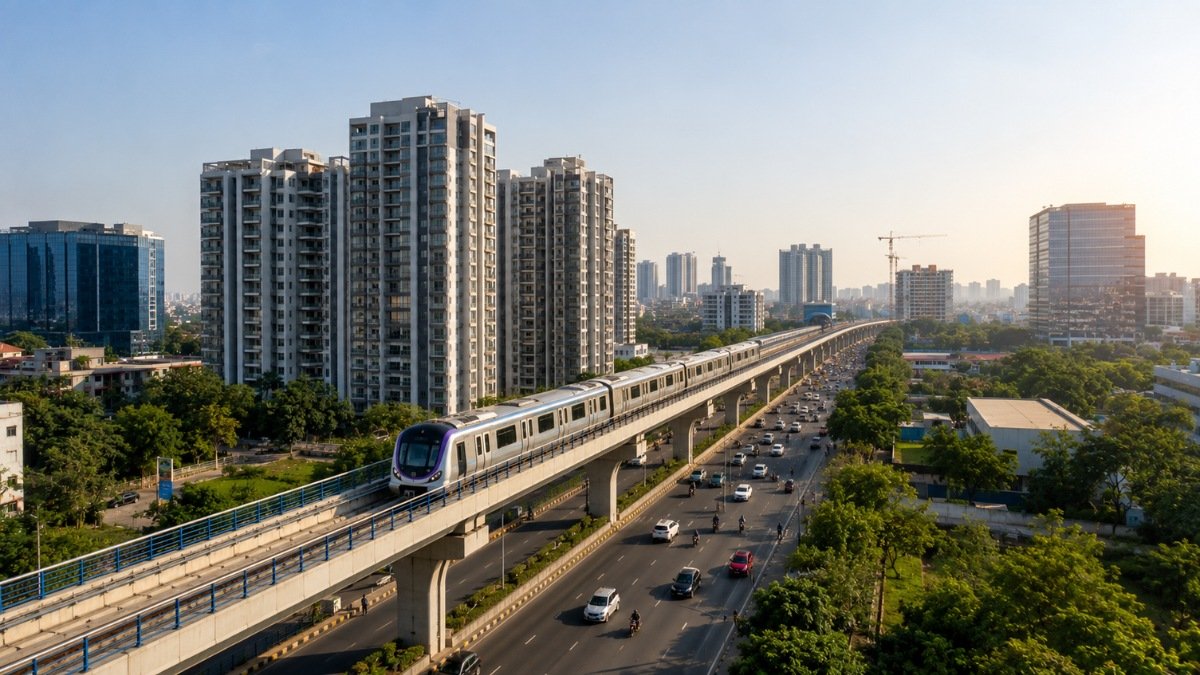
Infrastructure is the biggest single lever. The Pune Metro’s Line 3 (Hinjewadi Phase 3 to Shivajinagar) is cutting a commute of up to two hours down to roughly forty minutes — and properties within about 500 metres of metro stops are already appreciating 15–20% above the local average. The proposed Pune Ring Road is unlocking peripheral belts like Talegaon, Wagholi and the PCMC zone, while the long-horizon Purandar airport announcement is lifting land values nearby.
Analyst consensus points to 7–12% price appreciation in established IT-corridor localities through 2026–27, with peripheral and budget areas likely to see sharper gains as metro connectivity matures, and the overall city growing a moderate 5–10%.
| Segment / Corridor | Expected 2026–27 appreciation |
|---|---|
| Established IT corridor (Hinjewadi, Kharadi, Viman Nagar) | ~7–12% |
| West Pune (Baner, Aundh, Kothrud) | ~8–12% |
| Peripheral / budget (PCMC, Undri, Talegaon) | Above-average as metro matures |
| Overall Pune (city average) | ~5–10% (moderate) |
The main risk to watch is interest-rate sensitivity. A portion of the recent buyer cohort stretched EMI-to-income ratios in a lower-rate environment; a material rate rise could pressure the ₹1–1.5 crore segment. The RBI‘s rate trajectory is therefore the single biggest macro variable for 2026 pricing.
For end-users and long-term investors, 2026 is a favourable entry point — the market is demand-backed, moderately priced, and infrastructure-driven — but it rewards selectivity over speculation.
The overarching theme: this is a market to buy into on fundamentals, not to time for a quick flip.
For developers, brokers and agents, a demand-led-but-selective 2026 market means visibility and lead quality now matter more than ever — buyers research online, compare RERA credentials, and shortlist before they ever call.
When the market stops rewarding speculation, it starts rewarding the businesses that reach the right buyer at the right moment. That is a marketing problem as much as a construction one: ranking for high-intent local searches, appearing in Google’s AI-driven answers, and converting enquiries into site visits.
This is exactly the work we do. Our real estate digital marketing approach helps Pune developers and agents generate qualified leads, and if you’re evaluating partners, our guide on how to choose a digital marketing agency in Pune is a useful starting point. You can also explore our full services. For a related read, see our analysis on whether Pune property prices will fall in 2026.
Is the Pune real estate market growing in 2026?
Yes. Pune is in a stable, demand-led growth phase in 2026, with prices appreciating a moderate 5–10% annually and strong end-user demand, rather than a speculative boom.
Which area in Pune is best for property investment in 2026?
The IT corridors and their fringes — Hinjewadi, Punawale, Kharadi, Wakad — plus West Pune (Baner, Aundh) lead for 2026. Ring-Road peripheries like Talegaon offer the best value entry.
How much do flats cost in Pune in 2026?
Prices range from about ₹5,500 per sq ft in emerging peripheries to ₹14,000+ per sq ft in premium IT-corridor and central localities.
Will Pune property prices rise in 2026?
Consensus forecasts point to 7–12% appreciation in established IT-corridor localities through 2026–27, with the main risk being a sharp rise in interest rates affecting the ₹1–1.5 crore segment.
Is it safe to buy property in Pune in 2026?
For end-users and long-term investors it is a favourable, fundamentals-driven market. Buying RERA-registered projects from established developers significantly reduces delivery and legal risk.

If you’re a developer, broker, or agent looking to turn Pune’s 2026 demand into qualified leads and site visits, RaRi Softworks builds real estate digital marketing and local SEO strategies designed for exactly this market.
Contact us for a free real estate marketing and AI-visibility audit, and see how to get your projects in front of high-intent buyers across both Google and AI-powered search.
📍 2608, Bramhacorp Business Park, Wadgaon Sheri, Pune
📞 020 6901 0276
📧 saless@rarisoftworks.com
🌐 www.rarisoftworks.com
Pune’s 2026 market rewards the informed. Prices are climbing steadily, infrastructure is reshaping value street by street, and buyers are more discerning than in any recent cycle. For businesses in this space, being visible and credible online is now inseparable from selling property.
This analysis draws on 2026 Pune market data from JLL, Maharashtra’s Inspector General of Registration (IGR), Hindustan Times, and published market reports (Blox, Naiknavare, Banking Inputs, Casagrand, BeyondWalls). Price ranges are indicative and were current at the time of writing; buyers and investors should verify project-specific rates. This piece reflects RaRi Softworks’ work with real estate clients in the Pune market.
RaRi Softworks Research Desk
RaRi Softworks is a Pune-based digital marketing and business growth agency working with brands across real estate, infrastructure, technology, healthcare, hospitality, and local business sectors. Our research combines search behavior analysis, lead generation trends, consumer intent data, content strategy, and market intelligence to help businesses understand evolving customer demand in the digital era.
RaRisoftworks.com is a Pune-based digital marketing agency delivering practical strategies, measurable results, and long-term growth for businesses across industries.
2608, Bramhacorp Business Park, Wadgaon Sheri, Pune, Maharashtra 411014 India.
☎️ 020-69010276
Copyright © 2026 RaRi Softworks LLP, All Rights Reserved. V2.0
RaRi Softworks Research Desk RaRi Softworks is a Pune-based digital marketing and business growth agency working with brands across real estate, infrastructure, technology, healthcare, hospitality, and local business sectors. Our research combines search behavior analysis, lead generation trends, consumer intent data, content strategy, and market intelligence to help businesses understand evolving customer demand in the digital era.